Fancy Juti for Navratri, Karva Chauth & Diwali 2026: The Complete Festive Buying Guide
Navratri begins October 11, and from there it’s barely a month until Diwali on November 8 — nine nights of garba, then Dussehra, Karva Chauth, Diwali, and Bhai Dooj in quick succession. If you’re searching for fancy juti this week, you’re almost certainly shopping for one of those days, and you’ve probably noticed the same thing we have: most “festive footwear” guides show you pretty pictures without actually telling you what separates a fancy juti worth the price from one that looks the part in a product photo and falls apart after Navratri week.
This guide covers exactly that — what makes a jutti “fancy” rather than everyday, how to pick the right style for each festival on the calendar above, where punjabi jutti for women fits alongside it, and how to actually find the best juttis online instead of the first ad you scroll past.
What Makes a Jutti “Fancy”?
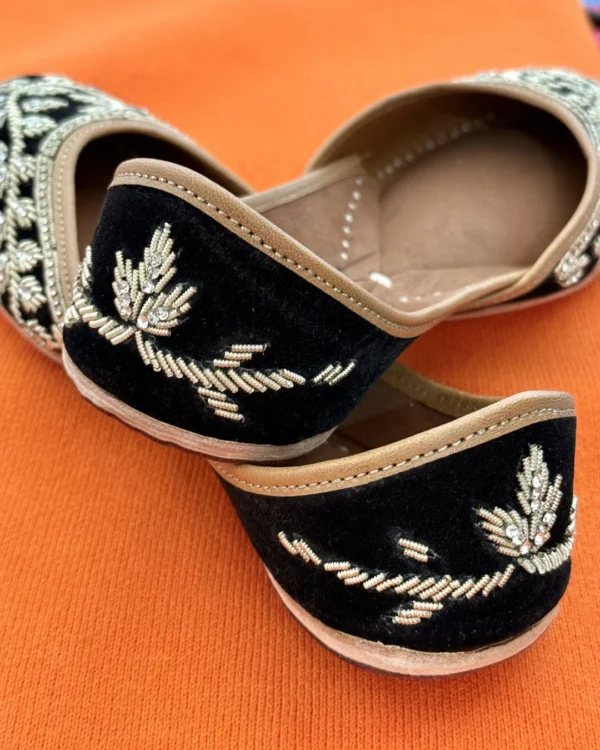
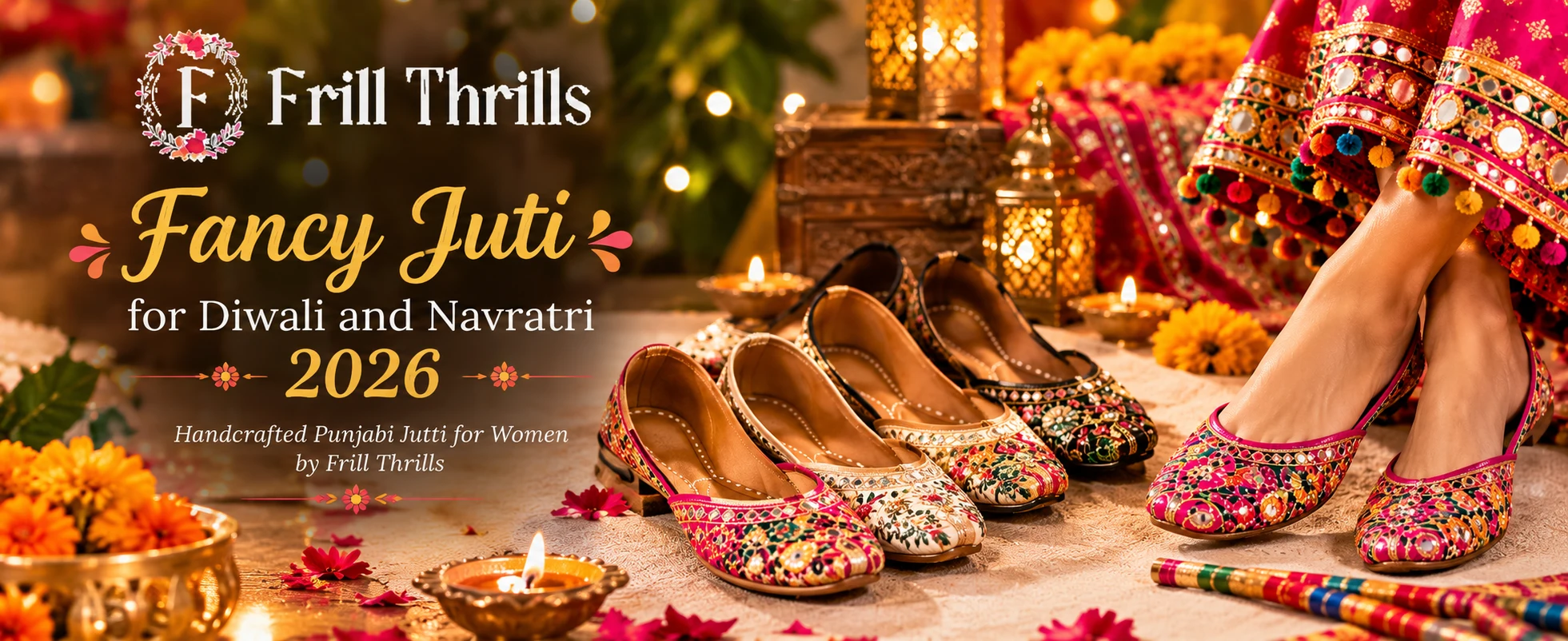
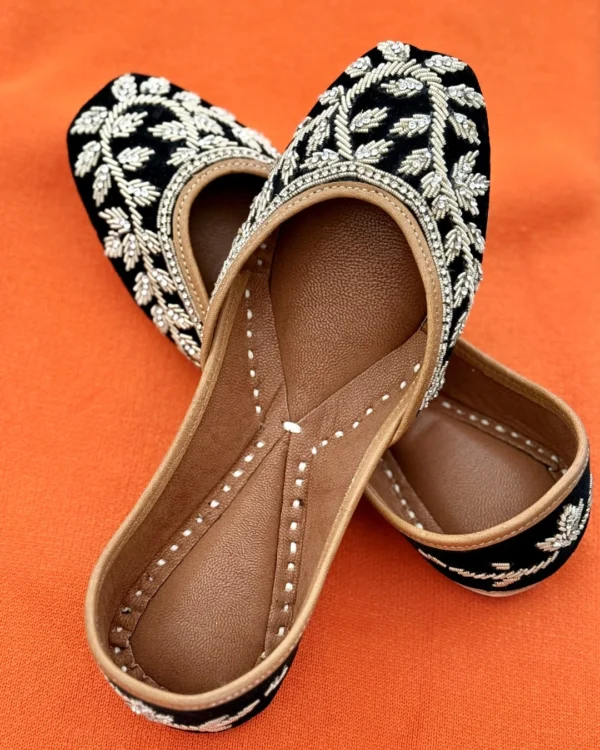
The line between an everyday jutti and a fancy juti comes down to three things: embellishment, material, and intent. Everyday punjabi jutti for women is usually simpler — clean embroidery, practical colors, built for repeat daily wear. Fancy juti is built to be the center of attention: heavier zari (metallic thread) or dabka (coiled wire) embroidery, sometimes gota work, pearls, or stone embellishment, in richer festive colors — maroon, gold, deep red, emerald, royal blue. None of that is just decoration for its own sake; it’s what makes a jutti read as festive rather than daily wear the moment someone sees it, which matters when you’re dressing for an occasion rather than an ordinary day.
Fancy Juti for Navratri & Garba Nights
Navratri is nine nights of actual dancing, so comfort has to come first even in a fancy juti — this is the one festive occasion where a heavily embellished, stiff pair will genuinely ruin your night rather than just look slightly off in photos. Look for a flat sole, lightweight embellishment (mirror work and lighter zari move well; heavy dabka and stonework don’t), and a true-to-size fit rather than sizing up for comfort, since a loose jutti is a tripping hazard on a dance floor. Color-wise, Navratri is the one festival where matching a specific day’s color scheme is common — if you’re following the nine-color tradition, a few versatile shades (red, yellow, white, gold) will carry you through more nights than trying to match all nine exactly.
Fancy Juti for Karva Chauth & Diwali Puja
Karva Chauth and Diwali call for the opposite approach — these are the occasions to go heavier. Rich zari or dabka work in red and gold is the traditional pairing for Karva Chauth, worn with a sari or heavily embroidered suit; Diwali puja looks lean similarly festive but allow more room for personal color choice beyond red. Because you’re standing and moving less on these two days compared to Navratri, this is where it’s worth choosing the most heavily embellished fancy juti in your wardrobe — the one you’d call your “best juttis online” purchase of the season.
Fancy Juti vs. Everyday Punjabi Jutti for Women — When to Wear Which
A simple rule that holds up across the whole festive calendar: if you’re dancing, working, or on your feet most of the day, reach for your everyday punjabi jutti for women or a simpler jutti for women style — comfort wins. If you’re the center of a specific ritual or celebration — Karva Chauth puja, Diwali Lakshmi puja, a sangeet — that’s when the fancy juti earns its place. Most people shopping this season end up buying one of each rather than trying to make a single pair do both jobs, which is also the more practical approach if you’re ordering online and want to be confident about fit before the festival itself.
Black Jutti: The Festive Minimalist’s Pick
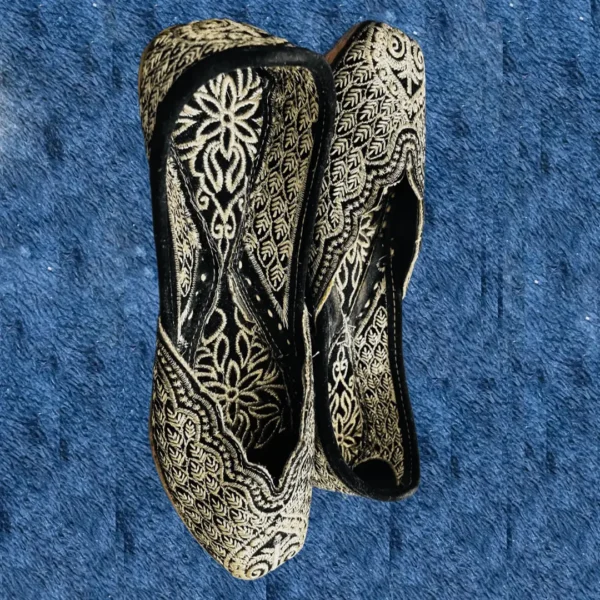
Not everyone wants to coordinate a different embellished jutti to every outfit across a month of festivals, and that’s a reasonable call — a well-made black jutti with just enough embroidery (gold zari or dabka against black reads richer than people expect) works across nearly the whole calendar above without needing to match. If you’d rather buy one versatile pair than five occasion-specific ones, black jutti is the single best substitute for a full fancy juti wardrobe.
How to Find the Best Juttis Online This Festive Season
- Check embroidery close-ups, not just the hero shot — zari and dabka work should look dense and even up close, not sparse or printed-on.
- Confirm the material explicitly — genuine leather juttis hold embellishment better over a full festive season than synthetic ones, which can crack or shed decoration faster.
- Order earlier than you think you need to. COD and pan-India delivery mean you’re not blocked by payment, but the week before Diwali is when every jutti seller’s order volume peaks — ordering during Navratri rather than the days just before Diwali gives you far more breathing room if a size needs exchanging.
- If you’re comparing spellings while searching — “juti” and “ladies juti” are the same shoe as “jutti,” just a different transliteration, so don’t limit your search to one spelling.
That’s the short version of what separates a good fancy juti purchase from a disappointing one this festive season — embellishment quality, genuine materials, and ordering with enough runway before the date that actually matters to you.
Frequently Asked Questions
What’s the difference between fancy juti and bridal jutti?
Bridal jutti is a subset of fancy juti built specifically for wedding-day wear — usually the heaviest embellishment, often in white, ivory, or gold to match bridal outfits. Fancy juti more broadly covers any embellished, occasion-ready style, including festive colors you wouldn’t typically see on a bride.
How early should I order fancy juti before Diwali?
Aim to order during Navratri (October 11 onward) rather than the final week before Diwali on November 8 — that gives enough time to exchange for size if needed, which gets harder the closer you get to the date.
Can fancy juti be worn for more than one festival?
Yes — a mid-weight fancy juti in a versatile color (gold, maroon, or black-and-gold) works across Navratri, Dussehra, Karva Chauth, and Diwali without needing a separate pair for each.
How do I care for embellished jutti so the embroidery doesn’t come loose?
Store them flat rather than creased, keep them away from moisture, and avoid machine cleaning — a soft dry brush for dust is usually enough between wears.
Is “juti” the same as “jutti”?
Yes — both spellings refer to the same traditional flat, closed-toe shoe; the difference is transliteration, not product type.
Is fancy juti comfortable enough for a full day of events?
A well-made one, yes — look specifically for a cushioned insole and true-to-size fit rather than assuming heavier embellishment means less comfort; the two are independent of each other if the jutti is well constructed.
-
 40%
OFF
40%
OFF
Juttis for Women
Black Dabka Work Jutti
Original price was: ₹1,499.00.₹899.00Current price is: ₹899.00.Select size
-
 40%
OFF
40%
OFF
Juttis for Women
Black Multi Floral Jutti
Original price was: ₹1,499.00.₹899.00Current price is: ₹899.00.Select size
-
 57%
OFF
57%
OFF
Juttis for Women
Black Punjabi Juttis & Mojaris
Original price was: ₹930.00.₹399.00Current price is: ₹399.00.Select size
-
Select size